|
|
 |
|
|
The Bridge Over River Kinzig with Il Circolo di Pietra
|
|
The Bridge Over River Kinzig with Il Circolo di Pietra
By Giovanni Tinazzo
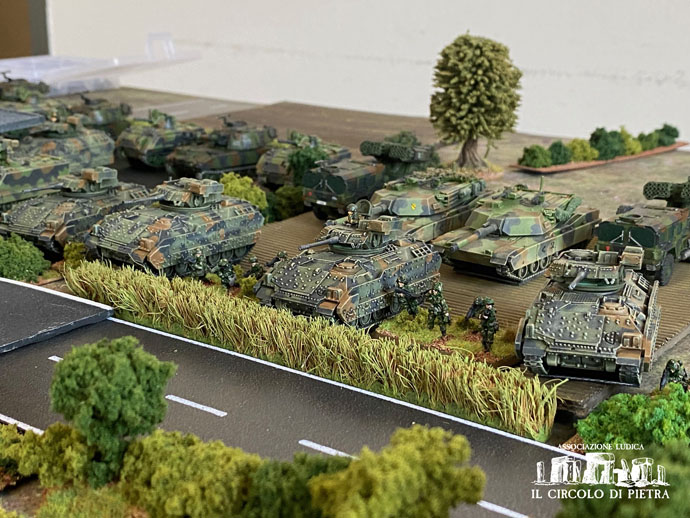
Every 3-4 months, the association "Il Circolo di Pietra" takes advantage of a weekend to set up and play a historical wargame scenario across multiple tables, using the 15mm systems of Flames Of War or WWIII: Team Yankee. A defining characteristic of these settings is a rather stringent narrative component, represented by clear Op-Ord that allow players to avoid the classic tournament match and instead engage in something different, where adhering to higher command's directives is rewarded!
|
|
The “Circolo di Pietra” represents one of the most established board gaming communities in the Vicenza area, having been active for over 25 years since its founding.
The association, legally constituted and recognized, has as its fundamental goal the promotion of non-technological gaming, aiming to remove the digital barrier of the screen in the interaction between players; all our activities require the presence of members on-site, thus facilitating an active social interaction that is increasingly rare in today's world.
Among our activities, we include board games, role-playing games, and three-dimensional wargaming, both in well-known fantasy/science fiction settings and in the less common but equally engaging realm of historical gaming!
|
|

|
|
Our latest scenario, played on 14/04/2024, saw us projected into 1985 – the year the Cold War became hot!
To avoid a classic tank confrontation, we set up lists focused on a heavily represented infantry component from both the Warsaw Pact and NATO allies. The main battle tanks were obviously present, but in reduced numbers, thus unable to be everywhere on the battlefield. To allow for significant air support deployment, we decided to play the scenario across four 90x120 tables arranged to form a 120x360 cm surface, representing the Soviet defensive setup that American troops would need to cross to seize the town. This way, anti-aircraft artillery from both sides could not effectively cover the entire table, leaving tactical options open.
With Russian troops now deployed along three defensive lines, the NATO operation was ready to commence, starting just before dawn with a rapid air insertion of Luftwaffe strike aircraft in the operational area, which helped cover the deployment of German paratroopers.
To simulate this surprise attack, we included a special rule for the scenario, rolling a die for each platoon; on a roll of 6, a team would suffer a loss. To recreate the densely built terrain, we also used square bases as the bases for the buildings, treating them as woods, ensuring a complete blockage of the line of sight.
|
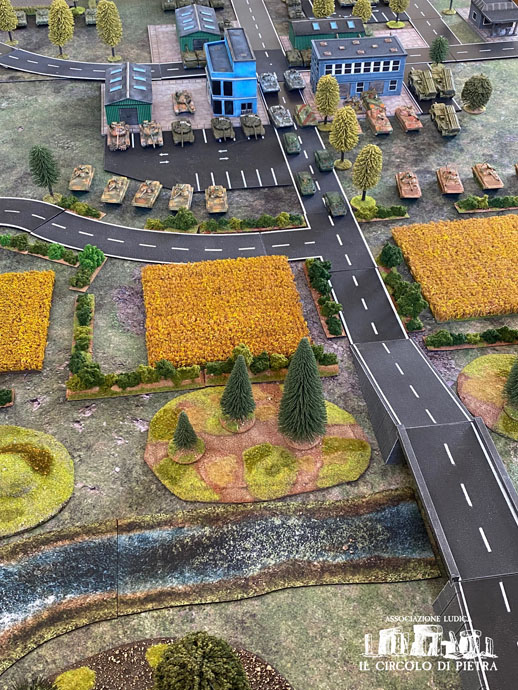 |
| The Russians, deployed! |
|
06:00 Hours
The preliminary passage of a squadron of Tornados covers the operational area with cluster bombs, causing limited damage to the main combat force but disabling several pieces of Pact artillery. This effectively marks the beginning of operations; just hours earlier, a masterfully executed drop of German paratroopers managed to deliver an entire company to secure the bridge, effectively cutting off the most advanced point of Russian troops from their rear, isolating it. The Fallschirmjäger have just enough time to prepare their positions before dawn.
|
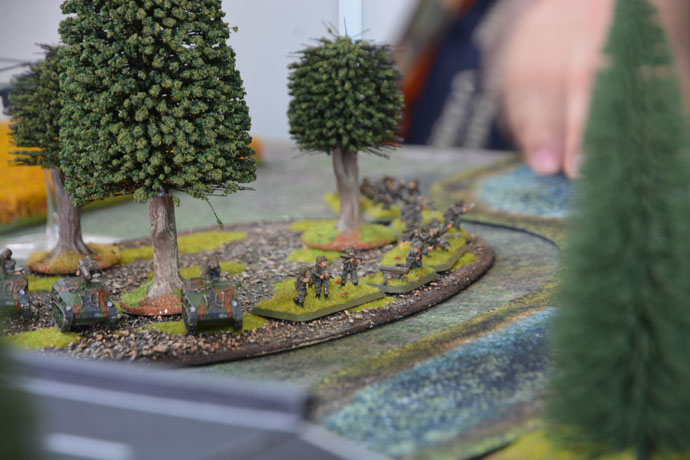 |
| The Fallschirmjager drop in. |
|
07:00 Hours (First Turn)
NATO forces attack the very first Russian defensive line, with the company stationed in trench positions facing the village coming under fire from an American infantry platoon and accompanying Bradleys. The positions hold; there are some casualties, but the company, although pinned down, stands firm and prepares to repel the American assault. The Russians fight fiercely, managing to reduce the number of attackers, but after a prolonged violent skirmish alternating phases, they yield, retreating with the few survivors they have left, a single infantry base. On the other side of the road, the second company seems to be spared from the opening salvo and hopefully waits for the Western forces not to notice them.
In the rear, a Russian reconnaissance unit begins to make contact with the bulk of the troops a few kilometers back; however, once they cross the bridge, they are quickly surrounded and destroyed by the Fallschirmjäger already in prepared positions. Now the Russians know they are trapped between the hammer and the anvil.
|
|
08:00 Hours (Second Turn)
The Americans take advantage of the daring sorties by the Tornados and the operational windows they create, although by now Pact anti-aircraft is much more active and begins to inflict losses. The mechanized platoon on the right side of the road, after clearing the Russian trenches, begins its advance into the first houses of the urban center, while another platoon prepares to assault the Russian company entrenched among the hedges; realizing they are cornered, they do not give up, pushing back the American infantry’s initial assault, pinning them down, and achieving a stunning result by destroying five Bradleys which, in an attempt to force the position, attack the Russians buoyed by their earlier success.
The Russian command slowly begins to position troops of the third line to seize the river and dislodge the German paratroopers from positions that, while good, do not seem impregnable.
|
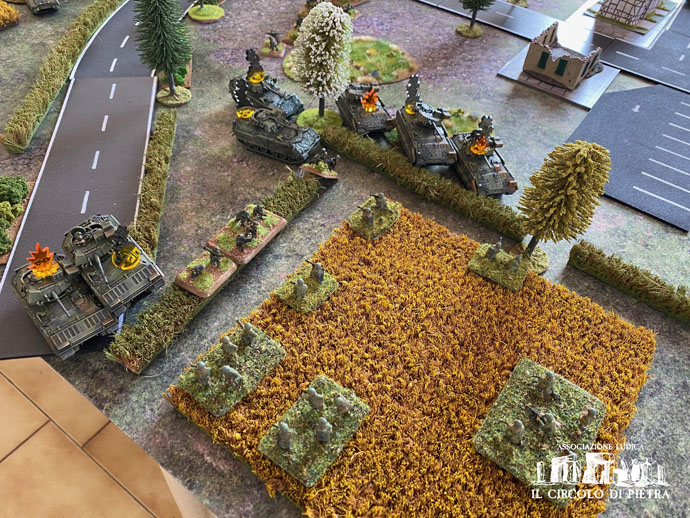 |
| The Americans fail to break through |
|
09:00 Hours (Third Turn)
Faced with a more stubborn resistance than expected, the Americans begin to bring up their Abrams to the contact line, confident they can easily outmatch the entrenched infantry. The American platoon, still shaken by the losses from the previous assault, regains its composure and, coordinating with the Bradleys of the third infantry platoon, prepares to vault over the hedge once more to dislodge the Russians. After a violent phase of not very accurate fire, they launch into the assault again, only to be repelled again with losses; the same terrible fate awaits other Bradleys shortly thereafter, whose efforts to overcome the storm of Russian defensive fire are in vain.
On the other side of the road, a reserve unit of Russian infantry begins to disembark from their BMP-2s and take position in the second line of buildings, ready to await the attack.
Meanwhile, near the bridge, a bitter surprise awaits the Russians; the paratroopers are not alone; they have been joined by anti-tank helicopters and have deployed well-camouflaged Wiesel vehicles, excellent platforms for anti-tank and anti-aircraft fire. Suddenly, the bravado of the Russian attack seems to wane.
|
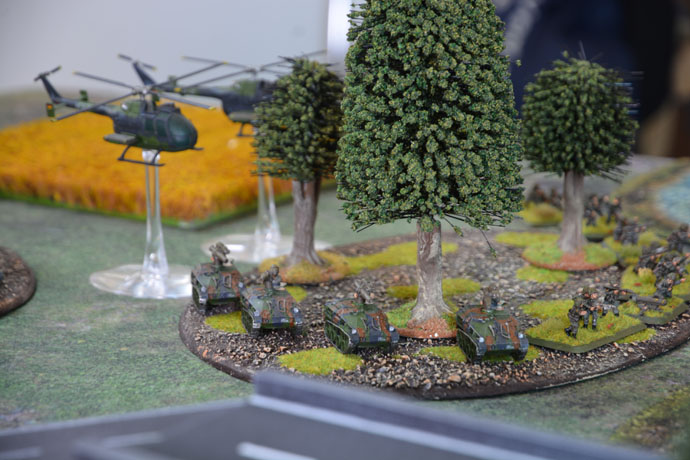 |
| The Fallschirmjager are joined by anti-tank air support! |
|
10:00 Hours (Fourth Turn)
Now alerted by the presence of the Abrams, the Russian sector commander authorizes the deployment of the T-80 reserve. These movements briefly grant the initiative to the Russians, albeit clearly for another reason.
Indeed, the exhausted American infantry, who have repeatedly assaulted the hedge, fall back towards the rear, and the American commander decides to unleash artillery fire across the entire cultivated area. At the same time, two Abrams move to take advantage of the moment and finally break through at that point, but after a brief duel with the T-80s, the surviving Abrams decides it is wiser to rapidly retreat from the engagement. With the cover of their best vehicles, the very shaken Russian defenders begin to pull back to the next defensive line.
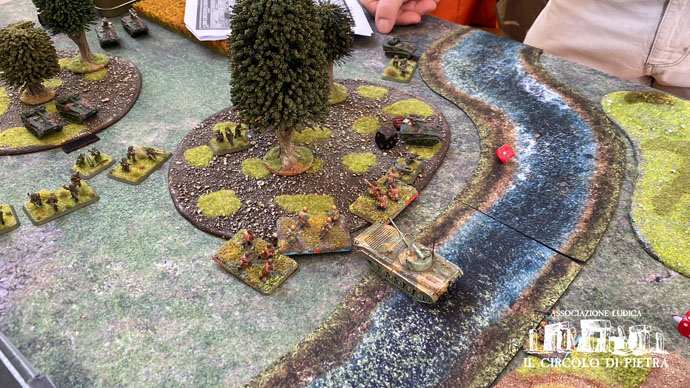
The Russian attempt to force the river proves complicated and bloody; some helicopters are destroyed with difficulty, and it seems an opportunity has opened near one of the now weakened positions.
|
|
|
| The Soviets push up across the river |
|
11:00 Hours (Fifth Turn)
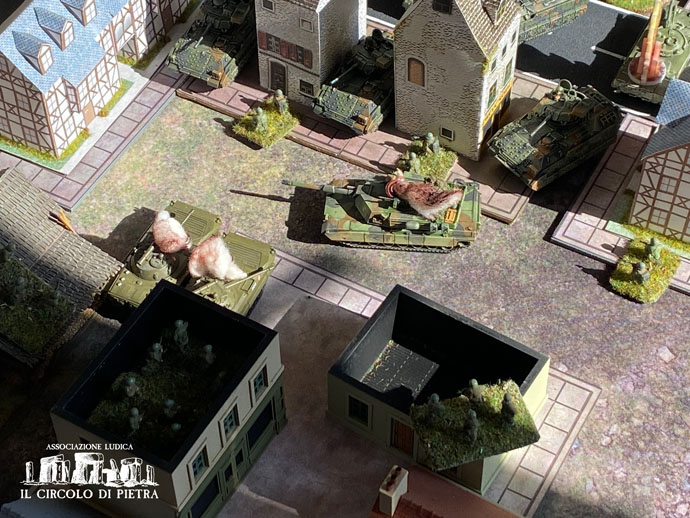
Having now reached their first objective of the day on both sides of the road, American troops begin pushing deeper into the town. The narrow streets become the stage for a lethal duel between BMPs and Bradleys; to the advantage of the latter. The Abrams platoon, kept at bay from the fighting until now, begins to close the distance with the defenders. The Russian infantry starts to fortify themselves in the houses.
Meanwhile, from another sector of the front, an additional mechanized infantry platoon and two Abrams arrive to reinforce the shaky American right flank, fresh forces that will soon join the battle. Announcing their arrival, two Cobras soar low skimming the tree tops, ready to strike the T-80s at the first opportunity.
For the Russian troops, this essentially becomes a moment of operational pause; on the left flank, the infantry that had to abandon the fortified area of the hedges manages to stabilize the front; however, nothing new happens in the bridge sector, as an initial Russian assault is bloodily repelled, and the few survivors scatter.
|
|
12:00 Hours (Sixth Turn)
After hours of intense fighting, NATO aviation reappears. A T-80 falls victim to the unwelcome attention of the Americans, miraculously escaping with only superficial damage and much fright for the crew who promptly evades the tank. While aiming to finish the job on the T-80s, the Cobras are targeted by the waiting Shilkas and disappear from targeting radars after a storm of projectiles.
The Abrams enter the urban center, only to be met by fierce defenders who manage to destroy one of them with a well-placed RPG, overcome the covering fire of the subordinate, who promptly fails the morale test to counterattack, and retreats hastily, ending up immobilized at the mercy of the Russians.
|
|
13:00 Hours (Seventh Turn)
In the early afternoon, the day essentially drifts into a stalemate; the American forces seem unable to breach the second Russian line, and the Russian forces cannot regain control of the bridge. Compounded by the heat of the midday phase, both sides take advantage of the inactivity to allow for a brief operational pause.
|
|
14:00 Hours (Eigth Turn)
Positioned at the edge of the town, the Americans begin to move their supports forward, mortars and VADS anti-aircraft units tighten the distance to the first houses, likely alerted by precise intelligence reports. The Abrams on the flank engage in battle with the T-80s, exchanging shots without surprises.
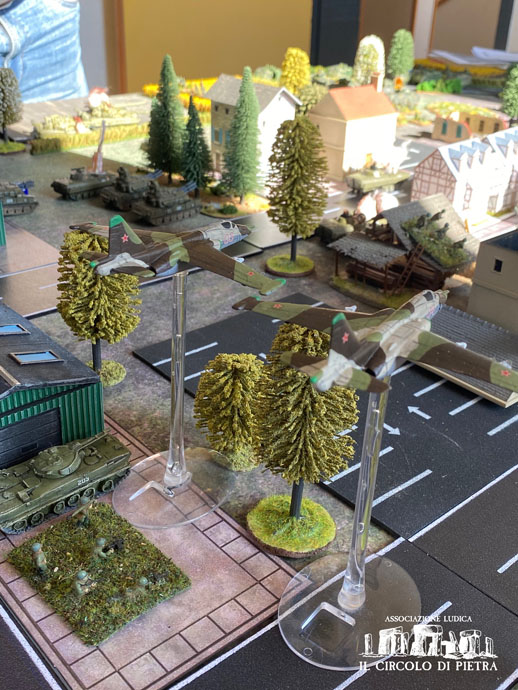
Soon after, two pairs of Su-25s burst onto the field. While one pair rushes towards the Abrams with ease; the other finds themselves unfortunately within the range of the VADS; despite excellent evasive maneuvers, only two Su-25s will return to base.
|
|
|
|
Urban Warfare
|
|
15:00 Hours (Ninth Turn)
Positioned at the edge of the town, the Americans begin to move their supports forward, mortars and VADS anti-aircraft units tighten the distance to the first houses, likely alerted by precise intelligence reports. The Abrams on the flank engage in battle with the T-80s, exchanging shots without surprises.
Soon after, two pairs of Su-25s burst onto the field. While one pair rushes towards the Abrams with ease; the other finds themselves unfortunately within the range of the VADS; despite excellent evasive maneuvers, only two Su-25s will return to base.
|
|
|
|
The Russian airforce arrives
|
|
16:00 Hours (Tenth Turn)
Positioned at the edge of the town, the Americans begin to move their supports forward, mortars and VADS anti-aircraft units tighten the distance to the first houses, likely alerted by precise intelligence reports. The Abrams on the flank engage in battle with the T-80s, exchanging shots without surprises.
Soon after, two pairs of Su-25s burst onto the field. While one pair rushes towards the Abrams with ease; the other finds themselves unfortunately within the range of the VADS; despite excellent evasive maneuvers, only two Su-25s will return to base.
|
|
|
|